 02 8319 2266 from Australia
 416-628-3473 from Canada
 04 889 4515 from New Zealand
 646-757-1102 from the USA


Switzerland: Trains
Welcome to Alpine Exploratory's Swiss trains page!
In this guide we explain the Swiss travel routes, based on our long exploration at Alpine Exploratory. We have drawn our conclusions over countless Swiss trips, since Alpine Exploratory was founded in 2005. Alpine Exploratory offers multi-day hiking routes in Switzerland and more widely in the Alps, Scandinavia, the UK and Ireland, both self-guided and guided.
Our most popular Swiss trail is the Walker's Haute Route from Chamonix to Zermatt. (All Swiss after the first stage-and-a-half in France.) We also love the Via Alpina from Sargans to Montreux (Simon's favourite trail anywhere) and we are bringing in the Jura Crest Trail from Dielsdorf near Zurich to Nyon near Geneva. The Tour du Mont Blanc spends 2 days and 2 half-days in Switzerland, as well as France and Italy.
Why is Swiss travel so fabulous?
Swiss trains are bang on time, they are regular, they combine beautifully with the Swiss buses, and the views from the windows are colourful and (in the mountains) mountainous.

My first trip to Switzerland was in July 2000. (A personal view by Simon Stevens.) I was traveling to Chamonix in France, and it so happened that Geneva had the airport. On that occasion I walked through Geneva to the Swiss-French border and the French trains. For Chamonix it happens that the route by road is direct, the route by French trains is reasonably direct (but longer, via St. Gervais) and the route by Swiss trains is longer still (though much more scenic, via Martigny). I have made these journeys countless times, like many Brits traveling to the Alps.
My wider Swiss exploration started in January 2005 when, after a snowshoe course in France, I ventured by rail into the Valais canton.
When in 2016 we began to add the Via Alpina to our programme, my Swiss campaign really took life. The Via Alpina route (formerly the Alpine Pass Route) from Sargans in the East of Switzerland to Montreux in the West, cuts across all the North-South trade routes of Switzerland. It takes a look at so many small side valleys each with their own rail links to larger towns. We could hardly avoid seeing the real Switzerland and we came to celebrate this and pursue it wherever we saw a bus route. We wanted a full coverage of routes off-trail into cities, to complete our Swiss service for hikers.
A simple approachOur central suggestion is to approach Swiss rail in passing, and by this we mean enjoying the scenery in the course of traveling about as opposed to focusing on the highly-advertised lines with red trains and improbable tunnels. There is so much to see across Switzerland. It is possible to see much without an elaborate booking and without crowds. It is also possible, and this is the trick, to ride some famous lines on normal commuter trains and to hop on and off at stations. This reduces the cost, keeps things quieter, and lets you see Swiss life as lived. The famous-name lines offer full-route trips and roof windows, but these are not necessary.
Some lines are more exacting in practical terms than others, and we would take a bit of extra care to plan when it comes to four lines: the Gornergratbahn above Zermatt, the Jungfraujoch above Kleine Scheidegg, the Glacier Express East of Brig, and the Bernina Express. Otherwise, choose the parts of the lines that fit your overall itinerary, and put those stations into the ticket machines when you want to go.
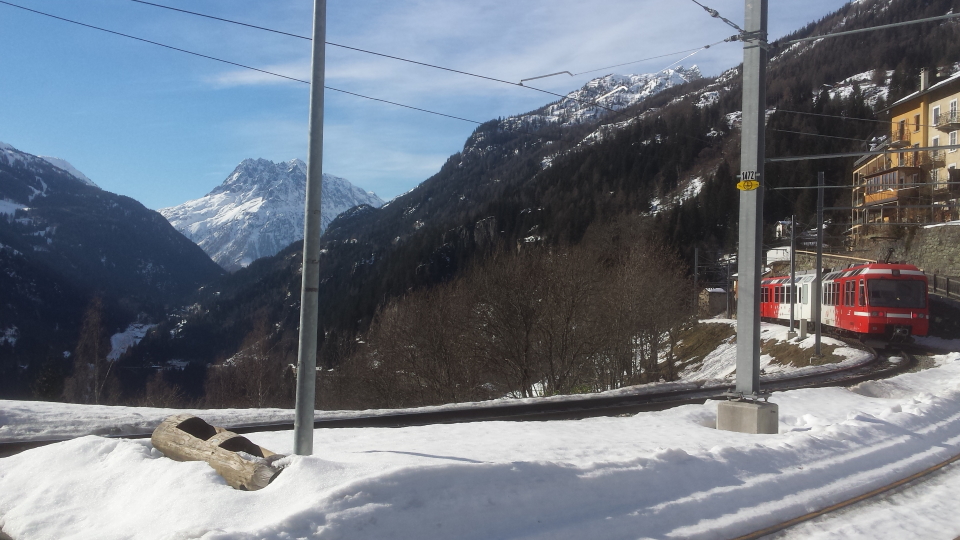
To jump straight to a popular approach to Swiss travel, let's look at the world of Switzerland's scenic rail lines. The classic image is a red engine pulling coaches with roof windows, on a stone viaduct that spans rock walls, the train popping directly from one tunnel onto the viaduct and into another tunnel, preferably with snow on trees. It really is like this, in the right places. Let's discuss these scenic lines:
1A The Bernina Express 
5 stars out of 5
2 hours
North-to-South route
From St Moritz to Tirana (Italy)
This might be the most stark and appealing Swiss railway line, the most mountainous, the line of bridges-into-tunnels of postcards and dreams. It is that, though as with any train, not everything can be seen from inside the train carriage itself! Heading South from St Moritz, the line builds up to a mountainous crossing of the Berninapass, then drops in improbable jumps to 4 distinct valley floors in succesion, finally cruising out into Italy, which it reaches in the last couple of miles.
1B The Glacier Express 
5 stars out of 5
6 hours
Mountainous through-route..
From Chur to Zermatt
.. of which up-and-back:
From Visp to Zermatt
Possibly the second-most impressive Swiss rail route of all, the first being the Bernina Express route St. Moritz to Tirana (above). This Chur-Visp route is the major East-West crossing of the Swiss Alps, linking the Eastern regions and the railway centre of Chur, with the Rhone valley in the Valais region. The best views are in descent from the high point, the Oberalppass (2,033m) as the train drops in hairpins to the ski town Andermatt. From Chur, take a first train to Disentis/Muster past massive riverside cliffs, largely in a rising valley floor. Change at Disentis for the high train to Andermatt, which clicks onto a cog rail as it climbs to the Oberalppass. At Andermatt change for a third train, to Visp. Without the tunnels-onto-viaducts extreme of other lines, this is Swiss travel of our dreams affording pastoral and romantic views of high Alpine life.
A note on the trains: ignore the Glacier Express itself, which is the separate rolling-stock with overhead windows and table service lunch. This is unnecessary and in fact the normal trains are the experience of normal Switzerland, a mix of local and walking people. Trains leave every hour to Disentis and from there the connections work seamlessly to Visp. At Visp of course we can connect with either the Zermatt trains or, on the main line now, the many-carriage intercities thundering to Geneva Airport.
If continuing to Zermatt, having come from either the Geneva or the Andermatt direction, or indeed down from Bern and Kandersteg, then the Visp-Zermatt section can be considered in its own right. It takes you up to the Mattertal, the high valley starting at roughly St Niklaus, for the final run to Randa, Tasch and Zermatt, a fine arrival in the shadow of the Matterhorn.
1C The Gotthard Panorama Express 
5 stars out of 5
5 hours
Mountainous through-route
From Luzern to Lugano
The Gotthard-Base tunnel (see Main lines below) renders this Gotthard Panorama Express line mainly for tourism. The original rail route over the mountains, it loops to gain height within the valley confines and it still needs the older, shorter, higher Gotthard tunnel, summit of the line. Look down on the resort of Andermatt. The sense of build-up to the high section is great fun and later the whizz through the dark Italian valley to Bellinzona is refreshing.
1D The Mont Blanc Express 
5 stars out of 5
2 hours 30 minutes
Mountainous through-route
From St. Gervais-les-bains-le Fayet to Martigny
This improbably-constructed line is a major link for our Tour du Mont Blanc walkers leaving Chamonix for the Swiss train network, and for Walker's Haute Route finishers returning to Chamonix. It is underated in general Swiss tourism terms. The line is shared with France and starts in St. Gervais-le-Fayet, France, climbing quickly into the upper Arve valley to Les Houches, Chamonix and Argentière. The real scenery starts above Chamonix, then inside Switzerland where the line hugs the inhumanly steep hillside looking across to Trient and the Aiguille Verte, and then - listen for the cogs engaging - drops slowly and steeply into the Rhone valley. Don't be afraid to switch sides to see both sides with the perspective of the drop underneath.
1E The GoldenPass Line 
4 stars out of 5
5 hours 30 minutes
Mountainous through-route
From Montreux to Luzern via Interlaken
A treat, and not extreme in terms of attention required or jostling undertaken, this rolling line just to the North of the mountains links Lac Leman with the Bernese Oberland junction of Interlaken, and later Luzern. There is a steep rise from Montreux to the hills and a definite entrance to the Swiss hinterland, then pastoral bliss around Gstaad. Look out for a change of trains at Zweisimmen. After Interlaken reach Meiringen (Sherlock Holmes fictional fame) and begin what is really the better half of the overall route, the Brunig line, with on the left side some exquisite sights into meadows with barns, then some utterly perfect villages. As man-made beauty it is hard to take in. This is not the sublime wilderness of higher lines but it is every bit as fun. Useful for the Via Alpina, really these are two separate lines and two separate types of rolling stock. It would be common to change at Spiez or Interlaken.

 The 5 big Swiss scenic rail lines (Map 1 of 6)
1A The Bernina Express (St Moritz-Tirano)
1B The Glacier Express (Chur-Zermatt)
1C The Gotthard Panorama Express (Luzern-Lugano)
1D The Mont Blanc Express (St. Gervais-les-bains-le Fayet-Martigny)
1E The GoldenPass Line (Montreux-Luzern)
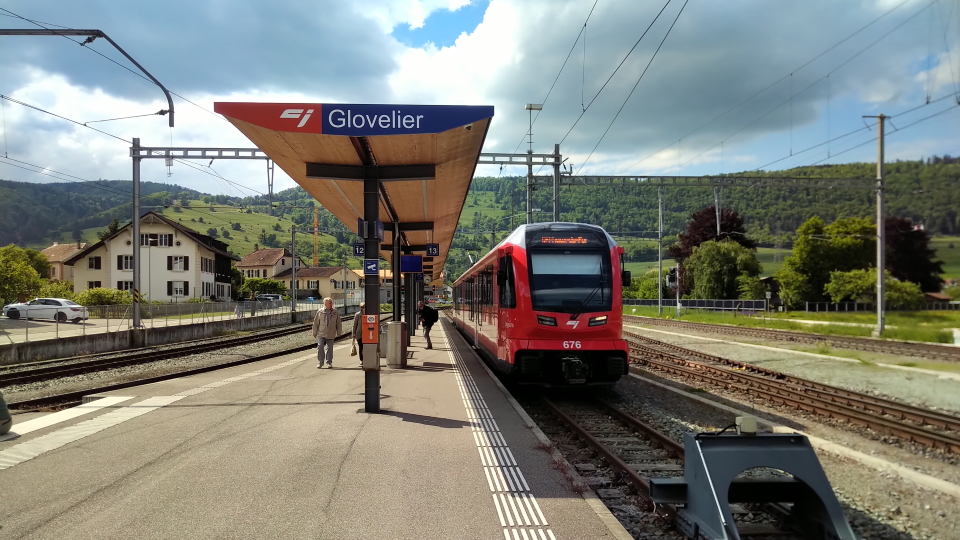 The train waits at Glovelier, bound back for La Chaux-de-Fonds.

Switzerland is known for its mountain railways: those routes going up mountains and down again instead of cross-country mountainous routes.
2A The Bernese Oberland routes including the Jungfraujoch 
5 stars out of 5
33 / 44 / 53 minutes to Grindelwald / Wengen / Murren
Three separate up-and-back routes..
From Interlaken to Grindelwald
From Interlaken to Wengen
From Interlaken to Murren including cable car from Interlaken to Grütschalp
.. and then a linking line and an extra mountain line
From Wengen to Grindelwald via Kleine Scheidegg
From Kleine Scheidegg to the Jungfraujoch
These are the trains that you've heard about if your neighbour goes skiing in Switzerland or if your aunt went on a Swiss sightseeing tour. There is no doubt that they are spectacular and, further, a central part of the Swiss mountain tourism set-up. To ride one of these lines, and not necessarily all the way to the Jungfraujoch ('Top of Europe' which it isn't really) is to sample what Switzerland offers. It happens that each of Grindelwald, Wengen and Murren (cable car required!) are stops on our Via Alpina. The linking Grindelwald-Wengen line largely shadows one walking stage. With a day to spare, the Jungfraujoch train is a possibility. The Jungfraujoch is the expensive and touristy rail tunnel up through the Eiger. (We have not yet ridden the Jungfraujoch.)
2B The Gornergratbahn 
5 stars out of 5
38 minutes each way
Up-and-back route
From Zermatt to the Gornergrat
Perhaps the most famous up-and-back route is the Gornergratbahn, a funicular that climbs a hillside above Zermatt to an observatory, cafe and viewpoint. The view is truly worth the trip, for here we are at 3,089m looking around the ring of famous peaks above Zermatt incuding the Monte Rosa and the Matterhorn. Sit on the Right going uphill. There is a popular, long, walk that drops right the way to Zermatt.
2C The Arosa line
5 stars out of 5
1 hour each way
Up-and-back route
From Chur to Arosa
Quietly, this is one of Switzerland's gems. A simple journey out and back, but with a ski resort and a lake to tempt you once there, the climb to Arosa is relentless and scenic. The route climbs first through fields and later on the edge of the hills. The train crosses the famous Langwieser Viaduct near Arosa. Arosa's ski resort is quite a big one.
2D The Rochers de Naye 
4 stars out of 5
45 minutes each way
Up-and-back route
From Montreux to the Rochers de Naye
At Montreux station a platform is reserved for this funicular which climbs to villages on a shelf and then increasingly enters the preserve of the open mountain, taking on some inspiring situations in its final curves to the station and cafe a few steps from the summit. At the summit are long views to Montreux tucked underneath and to Lac Leman. The walking descent is the last day of the Via Alpina and is exhilarating in its first half.
2E The Aigle-Leysin-Diablerets routes 
4 stars out of 5
From 30 minutes to 1 hour each way
Three separate up-and-back routes
From Aigle to Les Diablerets
From Aigle to Leysin
From Bex to Villars
This mini network of hillside lines is quietly spectacular and much less known than the Bernese Oberland ones. They are charming. Really these are three distinct lines near to each other. Expect forested ravines tumbling to rivers and a gathering sense of rural life in upper reaches. Diablerets is the one to go for, for the length of the line, for links by bus on to Gstaad, and for the village and setting itself.
 Highly scenic up-and-back lines (Map 2 of 6)
2A The Bernese Oberland routes
2B The Gornergratbahn
2C The Arosa line
2D The Rochers de Nayes
2E The Aigle-Leysin-Diablerets routes
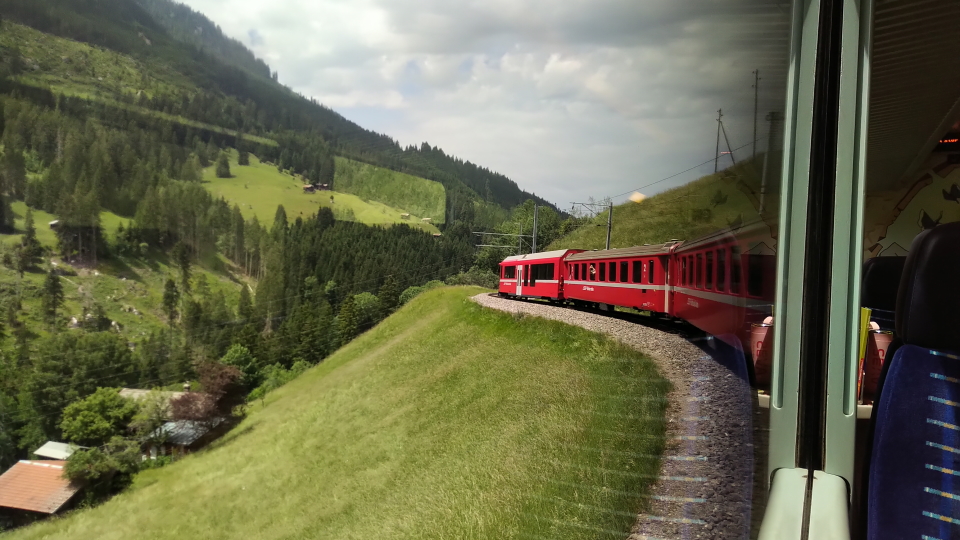
The best of Switzerland in our opinion comes on the train lines that are less highly charged in terms of scenery and tourism. These are lines that are important for hikers and that travel between mountains, while not being of the scenic calibre of the famous lines. We will look at the situation line by line. All over the country we find local train lines that are in use as normal commuter and resident lines, to villages, up hills, sometimes with a tourist angle but that can be treated as normal trains in terms of price and tickets. Sit with workers as they travel up to their site; hear locals chat in French, German or Italian.
3A Thusis to St Moritz
4 stars out of 5
1 hour 30 minutes
Mountainous through-route
From Thusis (or Chur) to St Moritz (or Samedan)
Linking with the famous Bernina Express, this line in fact has similar twists (loops) and tunnels, in fact those tunnels-onto-bridges of Swiss lore. Spectacular in a slightly less mountainous way than the Bernine Express, this is a fine precursor to get you into the mood.
3B Locarno to Domodossola 
4 stars out of 5
1 hour 53 minutes
Mountainous through-route
From Locarno to Domodossola
A wonderful little train that crosses this Swiss-Italian line of many gorges and mountain views, leaving (if you are doing so) Locarno in Switzerland for the jolly town of Domodossola. In Domodossola you are on the main line between Milan and Bern, and would find it hard to go wrong. Very much a part of scenic Switzerland this, and one of those wonders that are somehow off the beaten track.
3C Spiez to Brig 
4 stars out of 5
35 minutes
Mountainous through-route
From Spiez to Brig
This smaller main line has its own smart trains, storage racks turning from skis to bikes in Summer. Operated by BLS, this stands for Bern, Lotschberg and Simplon, being the city and the passes/tunnels of this company's routes. The line rises to a height around Kandersteg and passes through a tunnel, heading South, to a shelf high above the Rhone valley. It drops on a steady course to Brig with the valley (and Visp) below, opposite the hillside rising in the Zermatt direction.
3D St. Gallen to Linthal 
3 stars out of 5
2 hours
Rolling cross-country line
From St. Gallen to Linthal
The city St. Gallen is capitol of the canton also called St. Gallen and has kept quite a regional identity. This rolling farmland route crosses river valleys and is quite charming, later becoming more flat as it reaches the Zurich-Sargans main line at Ziegelbrucke. Now in the canton of Glarus the line enters a broad valley with the town of Glarus and, at the terminus, the village of Linthal. (At Linthal there is a cog railway up to Braunwald on a sunny shelf.) Linthal and Braunwald are towns on our Via Alpina which crosses Switzerland from East to West.
3E Luzern to Engelberg 
3 stars out of 5
40 minutes
Branch line
From Luzern to Engelberg
This is a pleasant branch line to the little mountain town of Engelberg. The town is a major stop on the Via Alpina (we make it the start of our central Bernese Oberland week) and the mountains crowd around as we near the terminus. Walk out of Engelberg's little station and find one of Switzerland's biggest walking signposts.
3F Yverdon-les-Bains to Ste-Croix 
3 stars out of 5
33 minutes
Up-and-back route
From Yverdon-les-Bains to Ste-Croix
From Yverdon-les-Bains, this modest train starts across fields before climbing steadily, in turns, to gain an improbable hillside on which sits the pleasant little town of Ste-Croix, a calling point on the Jura Crest Trail. If Ste-Croix doesn't work on timetables, try typing Sainte-Croix.
3G Nyon to La Cure 
3 stars out of 5
50 minutes
Up-and-back route
From Nyon to La Cure
Starting at Nyon, the fun little town at the end of the Jura Crest Trail and near to Geneva, the La Cure line climbs steadily, in woods at times, first to St-Cergue (bustling, pleasant, on the Jura Crest Trail) and beyond to La Cure which is smaller and which is on the border with France.
3H Andermatt to Göschenen
3 stars out of 5
15 minutes
Rolling line
From Andermatt to Göschenen
This key link is quick, through mountains and tunnels and beside a river, linking the North-South line to the East-West line. The lines themselves do not cross, as the North-South line is inside a tunnel. This key link makes sense of the 'intersection' that you can see on the Swiss rail map. The Andermatt to Disentis/Mustér section heading West (or East) is the main thing here in terms of scenery.
3I Saint-Bernard Express 
2 stars out of 5
Roughly 30 minutes
Branch lines
From Martigny to Le Châble
From Martigny to Orsieres
Two minor lines branch out from Martigny's mainline station to Le Châble and Orsieres, via a split at Sembrancher. The region is known as l'Entremont, between mountains, and the valley line to Le Châble feels this way. By contrast there's a climb to Orsieres and a small sense of a mountain railway. Generally the carriages from Le Châble run all the way to Martigny; from Orsieres you change onto this train at Sembrancher. At Orsieres, one bus carries on to La Fouly and another climbs to Champex. You might use these lines if linking stops on the Tour du Mont Blanc or Walker's Haute Route.
3J Montbovon to Bulle 
2 stars out of 5
30 minutes
Rolling line
From Montbovon to Bulle
The Palézieux–Bulle–Montbovon line, this route sets off from the unlikely Montbovon station, at a distinctive corner of the GoldenPass line between Montreux and Gstaad, to cross rolling farmland and pass the famous Gruyeres station. The cheese comes from the village, and here it is. At the end of the line, Bulle is a bustling French-style town and you can join further trains to Freiburg and Bern which are both exceptional. (A tourist offering called the Chocolate train is not necessary; it mirrors the route and uses some buses.)
3K Biel to La Chaux-de-Fonds
2 stars out of 5
41 minutes
Rolling line
From Biel to La Chaux-de-Fonds
A lovely little line that climbs gradually, and passes through a tunnel at the top of the hill, as it travels North West to La Chaux-de-Fonds, a surprisingly large town for its rural setting. Biel is known as Biel in the German or Bienne in the French.
3L Neuchâtel to La Chaux-de-Fonds
2 stars out of 5
28 minutes
Rolling line
From Neuchâtel to La Chaux-de-Fonds
A different approach to La Chaux-de-Fonds, early on taking a big corner of the hillside as the line climbs. Pass Les Geneveys-sur-Coffrane and Les Hauts-Geneveys on the way up, two stations that can be useful as ways off the Jura Crest Trail near Mont Racine.
3M Glovelier to La Chaux-de-Fonds
2 stars out of 5
1 hour 15 minutes
Rolling line
From Glovelier to La Chaux-de-Fonds
This pastoral, gentle, quietly scenic line passes through fields and woods, with farms and distant hills in the view. Near the Glovelier end, watch as the train stops and then carries on in the opposite direction.
3N Tavannes to Le Noirmont 
4 stars out of 5
40 minutes
Rolling line
From Tavannes to Le Noirmont
Simply wonderful, this short line is perhaps the most splendid non-mountainous line in all of Switzerland, simply for the peaceful, pastoral scenery. This small train meets larger trains at Tavannes (on the Biel to Moutier line) and journeys through fields and woods to Le Noirmont, a modest stop on the line from La Chaux-de-Fonds to Glovelier. A lovely day's exploration can be made of these scenic train lines in the Swiss Jura.
3P Biel to Moutier
3 stars out of 5
50 minutes
Rolling line
From Biel to Moutier
Climbing into the hills, the train curves spectacularly on leaving Sonceboz-Sombeval station, and takes a course North East towards Moutier, passing through some sweet examples of Jura countryside. On some journeys it will be necessary to change trains at Sonceboz-Sombeval.
3Q Biel to Ins
3 stars out of 5
34 minutes
Rolling line
From Biel to Ins
Classically Swiss, this simple local line connects the East-West line at Ins (Neuchâtel, Fribourg) with Biel on the North-South line. Look North for long views of the Jura Crest Trail on its ridge, with the big radio tower at Chasseral. Sweet.
 Scenic mountain lines (Map 3 of 6)
3A Thusis to St Moritz
3B Locarno to Domodossola
3C Spiez to Brig
3D St. Gallen to Linthal
3E Luzern to Engelberg
3F Yverdon-les-Bains to Ste-Croix
3G Nyon to La Cure
3H Andermatt to Göschenen
3I Saint-Bernard Express
3J Montbovon to Bulle
3K Biel to La Chaux-de-Fonds
3L Neuchâtel to La Chaux-de-Fonds
3M Glovelier to La Chaux-de-Fonds
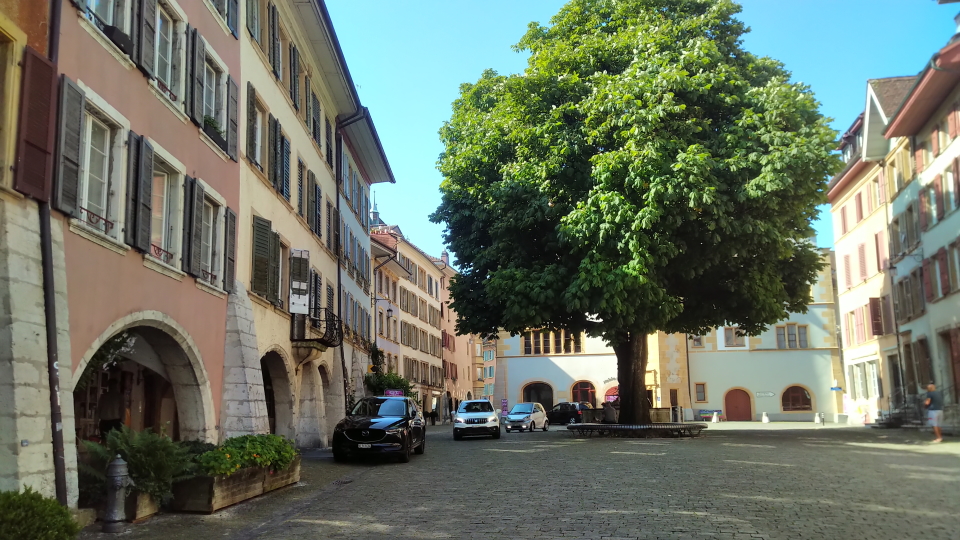
Swiss main lines are often scenic despite linking the major Swiss cities. This is more the case as we travel in the Alpine areas and bordering countryside. Everyday Swiss life, urban or semi-rural, is modest and well thought-out. Here we describe five of our favourite main lines. You are likely to take at least one of them on any Swiss trip, even just to reach the famous mountain lines above.
4A Geneva to Brig
3 stars out of 5
2 hours 30 minutes
From Geneva to Brig
For many travelers through Geneva Airport this is the line that counts. In 6 minutes you're at Geneva Cointrin, the main station, and then begins a fabulous glide along the length of Lac Leman. Stop at Lausanne, Montreux and then, in the distinct valley corner in the Valais, Martigny (change for Chamonix). Now heading North East up the Rhone valley pass Sion (Arolla by bus), Sierre (Zinal by bus), Visp (Zermatt) and lastly Brig (Milan). Mountain walls line each side.
4B Geneva to Bern
3 stars out of 5
2 hours
From Geneva to Bern
Also heading East from Geneva, at Lausanne this line diverges from Lac Leman and climbs onto a charming high table of farmland. Near Fribourg (a beautiful town especially in descent to the river) spot a gorge and river far below. To reach Bern is to see its special topography on an acute bend in the river, the rail lines approaching on high bridges.
4C Bern to Interlaken
3 stars out of 5
1 hour
From Bern to Interlaken
A valley route past Lake Thun to Interlaken, the interchange for the Bernese Oberland sights. Because of a cutting and the lake it is essential to sit on the Left heading South. This line is a tourist route in Summer and a skier route in Winter.
4D Olten to Lausanne
3 stars out of 5
1 hour 45 minutes
From Olten to Lausanne
Whizz through the valley on one of Switzerland's main lines, calling at Biel, Neuchâtel and Yverdon-les-Bains along the way.
4E Luzern to Lugano (Gotthard-Base tunnel)
2 stars out of 5
1 hour 45 minutes
From Luzern to Lugano
This 35-mile tunnel, the longest rail tunnel in the world, has transformed links with Lugano, capital of the canton Ticino and seemingly an isolated corner of Switzerland across the hills and speaking Italian. From Lugano life would seem to flow to Milan more than to Zurich. The link is spectacularly efficient and the only shame is that you don't see the hills, for a large part of the ride! The Northern and then the Southern valleys are interesting nonetheless and offer contrasts as well as sweeping viaducts jumping across deep chasms.
4F Biel to Bern
2 stars out of 5
30 minutes
From Biel to Bern
Unremarkable in Switzerland but probably super elsewhere, this handy direct train linking Biel/Bienne and Bern is faster than the main lines. Pass fields and factories, by and large on the flat.
4G Zurich to Sargans
2 stars out of 5
1 hour
From Zurich to Sargans
Fast with a lakeside stretch and with wide valleys revealing themselves head-on around Sargans. The routes head on towards the Austrian border (St. Anton, Innsbruck and ultimately Vienna) and this is also the route of the OBB Railjet express (maroon colour) from Zurich to Vienna.
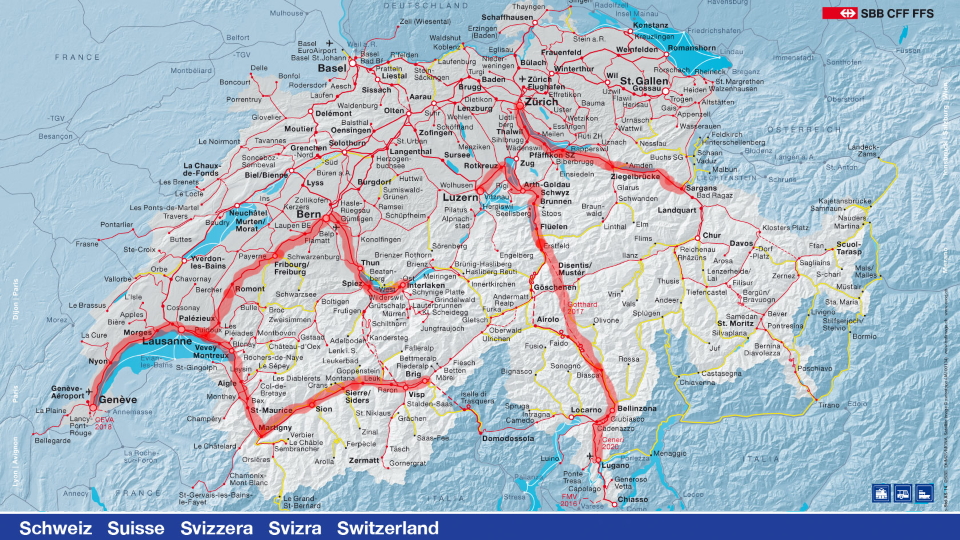 Main lines nonetheless very scenic (Map 4 of 6)
4A Geneva to Brig
4B Geneva to Bern
4C Bern to Interlaken
4D Olten to Lausanne
4E Luzern to Lugano (Gotthard-Base tunnel)
4F Biel to Bern
4G Zurich to Sargans
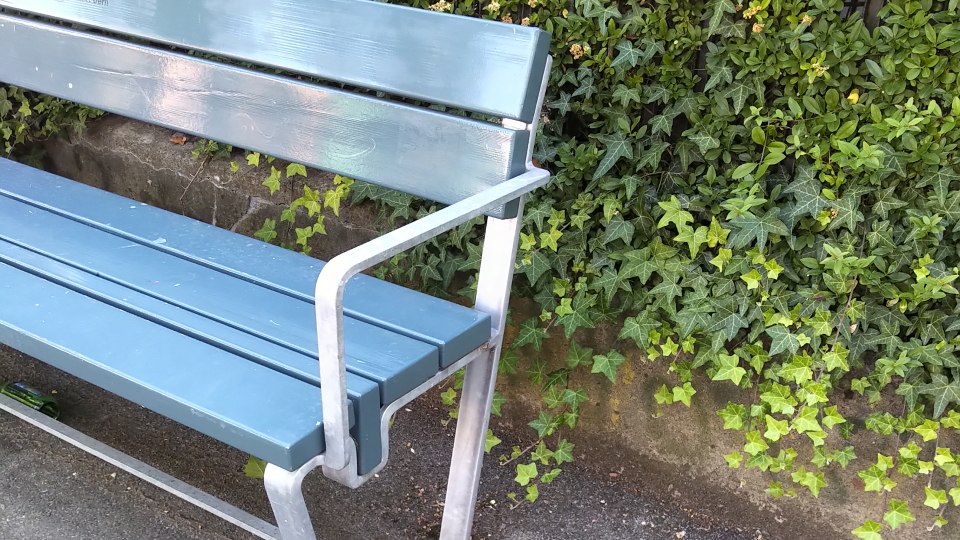 A Swiss bench in Bern. Describe a country based purely on its benches. What is a country like, that has such benches?
Via Alpina
A Swiss bench in Bern. Describe a country based purely on its benches. What is a country like, that has such benches?
Via Alpina
Switzerland has, like anywhere, lines of a less interesting nature and semi-urban lines that are simply practical rather than being a draw for tourists.
5A Morges to Bière and (via Apples) L'Isle 
3 stars out of 5
31 minutes to Bière, 14 from Apples to L'Isle
An up-and-back route to Bière, with a split of trains at Apples
From Morges to Bière
From Apples to L'Isle
Over rolling farmland with distant views, trains climb gently each half-hour, the main train going all the way to Bière and a separate train leaving from Apples (near the top) for L'Isle. L'Isle has Château d'Isle. A quiet corner of Switzerland away from crowds!
5B Lugano to Ponte Tresa 
2 stars out of 5
30 minutes
From Lugano to Ponte Tresa
This very frequent (every 15 or 30 minutes) commuter line from Ponte Tresa by the Italian border, into Lugano, runs around 3 sides of Lugano airport, for which the stop is Agno. Otherwise the line is unremarkable and largely free of hills, but offers further sights of life in Ticino. This line is one-metre gauge.
5C Liestal to Waldenburg 
3 stars out of 5
27 minutes
From Liestal to Waldenburg
This line, until 2021 in 750mm gauge and from 2022 in one-metre gauge, runs the 13km distance from Liestal into the hilly area to the South, where buses at Waldenburg take you across the hills to Balsthal which is on the Jura Crest Trail. This line is one-metre gauge.
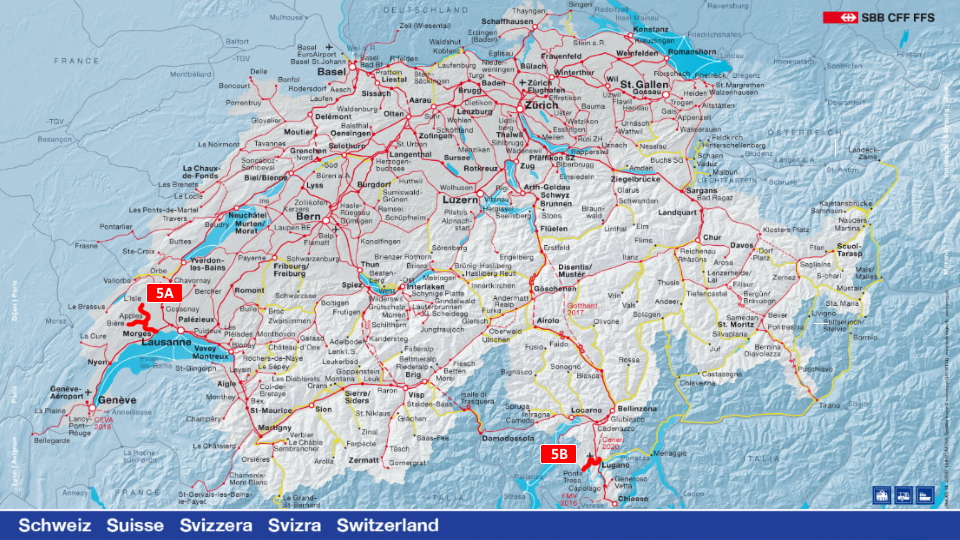 Little local and narrower lines (Map 5 of 6)
5A Morges to Bière and (via Apples) L'Isle
5B Lugano to Ponte Tresa
5C Liestal to Waldenburg
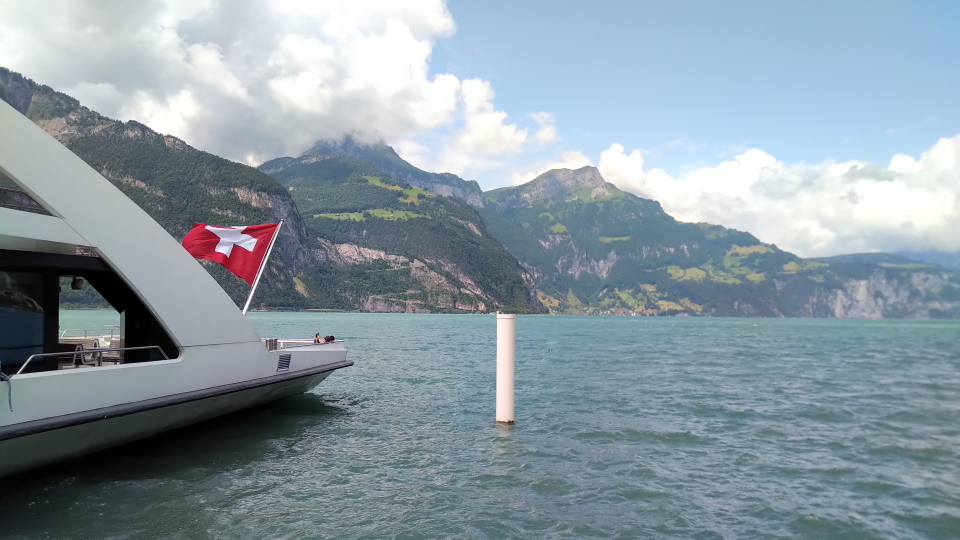
Swiss trains are the main event and take you to most places you need to go, but we would say that the Swiss experience is not complete without the PostBus. This is about the furthest evolution possible of the rural bus service. Crucially a bus route is treated the same on www.cff.ch as a rail route. Enter the destination you want, even if it ends at a bus stop, and the system will include the bus routes and bus fares needed.
One day on the bus from Altdorf, I stood behind the driver and watched as the 'Swiss PostBus driver's app' on his dash-mounted phone counted down the seconds until he was due to depart each bus stop, turned green, and he pulled off. It is that precise and orderly.
Scenically the best bus routes match the best train routes, with the extra touch of the tuneful tooting horns on hairpin bends. Socially, the PostBus is indeed also a postal service to villages and we experience a little of daily life.
Swiss bus practacalities
Swiss buses can be confusing at first. It is not normal to queue at the front and pay the driver. People tend to board at the back doors and just sit down. It is expected that passengers have a ticket, which will tend to be a through-ticket including the bus (as all Swiss bus stops are available at station counters or ticket machines or on www.cff.ch) or a local travel card. Ticket inspections happen and these are infrequent, but unforgiving. In everyday use it can certainly feel as if the driver is there just to drive, which might feel odd if you are from a society where paying the driver is commonplace. Swiss postbuses, however, are fabulously linked-up and efficient.
 The PostBus waits at the Klausenpass between Linthal and Altdorf. The peak is the Schachentaler Windgallen (2572m).
Via Alpina
The PostBus waits at the Klausenpass between Linthal and Altdorf. The peak is the Schachentaler Windgallen (2572m).
Via Alpina
6A Postbus: Biasca to Disentis/Mustér 
5 stars out of 5
2 hours, bus B140
From Biasca to Disentis/Mustér
This fabulous postbus route takes us from Biasca, a small stop on the main line to Lugano, to Disentis which is high in the German-speaking hills between Chur and Andermatt. The bus crosses the linguistic border just North of Olivone and the Lukmanier Passhöhe, the col next to the lake below, the Lai da Sontga Maria. We climb steadily from Biasca to the hills above. At Disentis/Mustér, take the mountain railway one way to Andermatt, or the gently descending train through the hills to Chur the other way.
6B Postbus: Tirano to Lugano
5 stars out of 5
3 hours, bus BP5950
From Tirano to Lugano
This notable postbus route links the end of the Swiss Bernino train, above, at Tirana through Italy and back into Switzerland at Lugano. Tirano is actually in Italy, and the vast majority of this bus route is in Italy. (We have not yet ridden this bus.)
6C Postbus: Thusis to Bellinzona
5 stars out of 5
1 hour 45 minutes, bus B171
From Thusis to Bellinzona
This is another of the bus routes that jump off the map of the South East of Switzerland, in the Engadine area, useful for linking up these distinct valleys. It's a surprisingly fast bus on dual carriageways in the valley floor, mountains either side.
6D Postbus: Thusis to Castione-Arbedo
5 stars out of 5
2 hours 30 minutes, bus B541
From Thusis to Bellinzona
This bus is roughly equivalent to the B171 above, taking you from Thusis outside Chur to a station (in this case Castione) with trains to Lugano. This route takes a lot of the same dual carriageways as the B171 but adds twists, and is marginally more scenic. The bus pauses for a few minutes at Mesocco towards the end.
6E Postbus: Sion to Arolla
5 stars out of 5
1 hour 20 minutes, bus B381
From Sion to Evolène, Les Haudères, La Sage, Ferpècle and Arolla
Pass sandstone pinnacles as the route climbs to Evolène, charming main town of the upper Val d'Hérens. At Les Haudères (some buses need a change here) a bit higher up, the bus waits so that people can change to La Sage and to Ferpècle (at the foot of the high mountains) and the main event begins, the climb up hairpin bends to Arolla. This tiny resort is tucked under snow-capped 3,000m mountains like the Pigne d'Arolla. This route is handy on the Walker's Haute Route.
6F Postbus: Sierre to Zinal
5 stars out of 5
1 hour 10 minutes, bus B451
From Sirre to Grimentz, Saint-Luc, Zinal
Similar to the Sion-Arolla route but one valley over in the Val d'Anniviers, the finish is a choice of three moderately high villages of which Zinal is the largest and Saint-Luc is the highest, with buses changing at Vissoie part-way. The climb up into the high valley is among the best we know, with multiple hairpins and seemingly bolted-on roads running beside huge drops. It's quite improbable. This is another bus route that links with the Walker's Haute Route.
6G Postbus: Meiringen to Grindelwald
4 stars out of 5
1 hour 40 minutes, bus B164
From Meiringen to Grindelwald
Running alongside a stage of the Via Alpina, the bus climbs steadily through a high valley to the Grosse Scheidegg, at which point the Eiger and the whole Bernese Oberland area are revealed. This route is priced quite high to match the general prices of the Wengen-Grindelwald-Murren cable cars and trains. A change of bus is needed at Schwarzwaldalp part-way up.
6H Postbus: Les Diablerets to Gstaad
4 stars out of 5
1 hour, bus B180
From Les Diablerets to Gstaad
Another link on the Via Alpina, this route crosses the French-German linguistic border at the Col du Pilon and is pastoral in theme as it drops steadily to Gstaad, the smart resort town. What is handy about this route is that it links two railways and makes an adventurous route possible from Martigny to Bern.
6I Postbus: Linthal to Altdorf
4 stars out of 5
2 hours 10 minutes, bus B408
From Linthal to Altdorf
This long route is another that traces the Via Alpina, covering two walking stages in this instance. Climb to the upper valley of Unterboden, massive cattle country, to the grassy Klausenpass and the twisty drop to valley town Altdorf. Dramatic.
6J Postbus: Fluelen to Göschenen
4 stars out of 5
1 hour 10 minutes, bus B401
From Fluelen to Göschenen
This bus runs near, twisting in and among, the train South to Göschenen which is on the old line (tunnels and loops) to Lugano, and which links to Andermatt for East-West trains. We see much of industrial, everyday Switzerland here in a tumble of scenery as we climb South.
6K Postbus: Yverdon-les-Bains to Vallorbe
3 stars out of 5
55 minutes, bus B613
From Yverdon-les-Bains to Vallorbe
Starting on valley dual-carriageways and ending on green hillsides, this is a fast route that takes you into the country, linking up with the Jura Crest Trail.
6L Postbus: Waldenburg to Balsthal
3 stars out of 5
22 minutes, bus B94
From Waldenburg to Balsthal
Handy for the Jura Crest Trail, this bus links up the tram-train line from Liestal to Waldenburg, with the railway at Balthal which is linked to Oensingen on the main line. The bus crosses a road pass (the Passhöhe at Langenbruck, with attractions) that is not really viable for the railway - not that that always stops the Swiss!
 The fabulous Swiss PostBus (Map 6 of 6)
6A Biasca to Disentis/Mustér
6B Tirano to Lugano
6C Thusis to Bellinzona
6D Thusis to Castione-Arbedo
6E Sion to Arolla
6F Sierre to Zinal
6G Meiringen to Grindelwald
6H Les Diablerets to Gstaad
6I Linthal to Altdorf
6J Fluelen to Göschenen
6K Yverdon-les-Bains to Vallorbe

Generally Alpine Exploratory advises that if your main purpose is getting to and from a hiking route, then a Swiss rail pass will not be worth it. A Swiss rail pass can be worth it if you plan a very extensive week or more of rail travel.
The theory
Swiss rail passes cost an amount of money and give you the ability to buy half-price tickets for the duration of your pass. Then when buying a ticket at a counter, ask for half-price (and show your pass) and when buying at a ticket machine choose 1/2 instead of 1/1. On the train you'll be asked to back up your 1/2 ticket with your pass, and Swiss conductors are reliable and businesslike (as well as polite and friendly). The pass also works for buses and ferries.
Whether to buy a pass is a question that we are asked frequently, and our answer is generally no, unless you plan a week of fairly solid Swiss rail travel. For a trek with the possibility of some intermediate travel (and the Walker's Haute Route might have a little and the Via Alpina has more) plus a train ride from and to airports either side, buying a half-fare pass is almost certainly far from worth it.
One good approach is to buy certain long-distance trips in advance, online, if you are sure of your timings. This can give some savings. Then buy local tickets on the ground, paying full price as you go. Generally when the Alpine Exploratory team travels within Switzerland, and we do this extensively in any given year, we pay as we go.
An example
As an example, in May 2026, Simon spent 6 days travelling in Switzerland, on this particular occasion making heavy use of the railways and buses. Simon spent about CHF 400, for which the saving with a half-fare pass would have been CHF 200. If a pass had cost CHF 150 then it would have been worthwhile. More usually on a trip, however, we'd spend CHF 100 on the railways, and thus the CHF 50 saving wouldn't have been worth the CHF 150 railcard.

Suppose you will be in Zermatt after the Walker's Haute Route. You can't avoid seeing a lot of Switzerland, as your airport choices are chiefly Geneva Airport and Zurich Airport. These are roughly 4-hour train journeys and involve superb scenery whether valley or mountain. Milan is reachable if you fancy the trip South into Italy, and there Milan Linate is infinitely the preferable of the two airports. If you have extra time then you could make trips as follows:
In 1 night from Zermatt:
Day 1 Train from Zermatt to Brig (part of the Glacier Express), train from Brig to Spiez, then train from Spiez to Bern (Stay in Bern)
Day 2 Train from Bern back to Spiez, train from Spiez to Montreux (GoldenPass Line), then train from Montreux to Geneva and fly.
In 2 nights from Zermatt:
Day 1 Train from Zermatt to Brig (part of the Glacier Express), train from Brig to Spiez, then train from Spiez to Bern (Stay in Bern)
Day 2 Train from Bern to Luzern via Interlaken (Stay in Luzern)
Day 3 Train from Luzern to Zurich and fly.
In 3 nights from Zermatt:
Day 1 Train from Zermatt to Brig (part of the Glacier Express), train from Brig to Spiez, then train from Spiez to Grindelwald via Interlaken (Stay in Grindelwald)
Day 2 Train from Grindelwald to Interlaken then train from Interlaken to Luzern (Stay in Luzern)
Day 3 Train from Luzern to Lugano (Stay in Lugano)
Day 4 Train from Lugano to Milan and fly
Now let's look at a finish in the West of Switzerland, for example at Chamonix after the Tour du Mont Blanc or at Montreux after the Via Alpina:
In 3 nights from Chamonix (France):
Day 1 Train from Chamonix to Martigny (Mont Blanc Express, which enters Switzerland at Le Chatelard-Frontiere), train from Martigny to Aigle and train from Aigle to Les Diablerets, then bus from Les Diablerets to Gstaad (Stay in Gstaad)
Day 2 Train from Gstaad to Spiez, train from Spiez to Interlaken, then train from Interlaken to Wengen (Stay in Wengen)
Day 3 Train from Wengen to Grindelwald via Kleine Scheidegg, then bus from Grindelwald to Meiringen over the Grosse Scheidegg and train from Meiringen to Luzern (Stay in Luzern)
Day 4 Train from Luzern to Zurich and fly.
In 3 nights from Montreux:
Day 1 Train from Montreux to Spiez then train from Spiez to Luzern (the whole GoldenPass Line) (Stay in Luzern)
Day 2 Train from Luzern to Zurich then from Zurich to Bern (Stay in Bern)
Day 3 Train from Bern to Lausanne (Stay in Lausanne)
Day 4 Train from Lausanne to Geneva and fly.
Heading into France.. or Switzerland?
We are sometimes asked about Lac d'Annecy in France as a destination after the Tour du Mont Blanc. It is a popular holiday lake and town, and in theory it fits after a trek that starts and ends in Chamonix which is also in France. We generally advise that heading into Switzerland instead, which is easy via Martigny, gives more enjoyable travels. Train routes on the French side of the Alps are not intuitive or always convenient and the coordination with buses to further rural destinations is harder to plan. Once there, Lac d'Annecy is liable to underwhelm. By contrast Switzerland has so much and is so simple.
Heading into Austria.. or Switzerland?
If you will be hiking the Adlerweg then you could explore Austria for several more weeks if you had time. Following your bold East-West trajectory, however, once at St. Anton you could jump on the train towards Zurich. Get off at Sargans, which is a pleasant example of a mildly historic working Swiss town, and change for Chur, to give yourself many options for the famous scenic rail lines.

As a note on the ten biggest Swiss cities, we would say that Bern, Basel, St. Gallen and Lausanne are lovely, Luzern is touristy and neat, Zurich is businesslike and neat, Lugano is sunny and smart, Winterthur is stately and smart, and Geneva and Biel are possibly the least appealing of all but still have plenty of interest including their old towns.
Please see our short opinions of each of these cities:
 Travel in the Alps: Cities
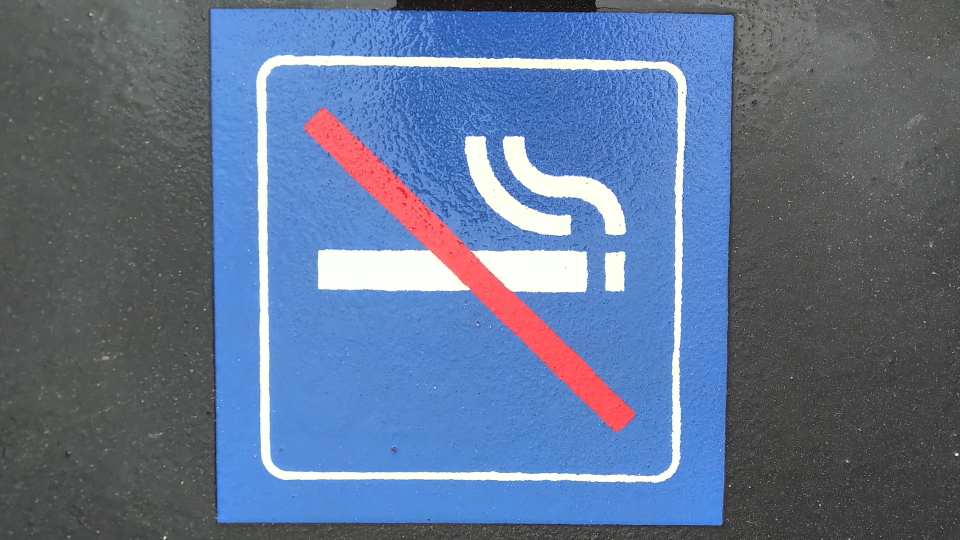 A Swiss no-smoking sign, on a damp station platform. Simplicity, elegance, even flair...
Jura Crest Trail
A Swiss no-smoking sign, on a damp station platform. Simplicity, elegance, even flair...
Jura Crest Trail
It is simple to continue by train to Geneva Airport and Zurich Airport. Every one of the express trains from the Lausanne or Zurich directions going into Geneva, continues for the 6-minute journey to Geneva Airport. It could hardly be easier and the airport is very close-in to the city. This means that even from far away, as in Zurich, Bern or Brig, you can time your Geneva Airport arrival quite precisely.
At Zurich the airport is on the main line towards Winterthur and your train might continue there, or else it is a simple change to the ultra-frequent airport trains.
Basel is a different situation as the airport, despite its size, is not on a train line. It is necessary to reach Basel's main station (called Basel SBB to distinguish it from the minor French-side station) and change for the frequent airport bus which departs outside. As with everywhere in Switzerland you can include the bus fare on your ticket by setting your destination as Basel airport.
Yes, it is possible to leave London in the morning and reach Switzerland in one day using the Eurostar and French/Swiss trains.
At Alpine Exploratory we do exactly this, regularly, and we love it.
Starting from London, typically we board the 8:01am Eurostar from London St. Pancras. This involves arriving at St. Pancras at 7am or so. This Eurostar gets into Paris Gare du Nord at about 11:30am. It is then a short walk around the corner to Paris-Est station, or a longer metro (half an hour) or walk (one hour and a half, via République and Bastille) to Paris Gare de Lyon station, for onward trains across France to Basel or Geneva in Switzerland. Generally you would arrive in Basel or Geneva in the late afternoon, with time to take trains across Switzerland if you wished.
Our favourite way to Switzerland is the Eurostar and then the Paris-Est to Strasbourg train in just under 2 hours, changing for the slower train down through France (through Mulhouse and so on) to Basel. It is also a pleasant option to take the train from Paris-Est to Stuttgart in Germany, and travel onwards from Stuttgart into Switzerland.

What are Swiss trains like onboard?
Generally, trains are long inter-city types with a diesel or electric locomotive at the front. Smaller rural lines might have electric sprinter-type trains with a driver in the front of the first carriage and a mix of modern seats. Most often, carriages are sparsely populated and you will find a whole seat, often a 4 around a table, for yourselves. Seat reservations are unheard of. At peak times in and out of large stations on the inter-city routes, trains can be busier and you might share your 4 with laptop-tapping commuters.
Trains do not generally wait for connecting trains to come in, if late, but in some local situations the branch line would wait for the mainline express. I have only been caught out once, at Brig, where I did make my connection but had to run. It was a shock!
Nothing is perfect and the Alpine Exploratory team has experienced delays on the Swiss network, but they are so rare. This is quite simply the best rail network in Europe.
The iconography of the Swiss railways is rather fine and not just the black and red 'Swiss station clock' that has become an international clock image. The logos and materials, as well as the paintwork on rolling stock, have their own simplicity and flair. Various cantons and individual lines have their own graphics and colours, to add local interest as you travel cross-country. For example, the mountainous line from Spiez to Brig keep its own grey-and-green Bernese scheme.
Do not be purturbed by graffiti on the side of some rolling stock. In a very neat and safe country it seems that graffiti is a form of expression that is tolerated more than we'd expect. Train interiors are uniformly spotless.
Otherwise, the thundering red-grey-blue express trains in the valley and the golden yellow postbuses winding their way over a pass, are sights to stir the emotion.
Buying tickets
The Swiss ticket machines are, simply, very good. Nowadays they make things even faster for you by assuming the basics and letting you just confirm your ticket. Change it if you want a return. What is referred to as '1/1' is full-fare, where 1/2 means half-fare. If you travel with a 1/2 fare ticket then you can rely on being asked for your travel pass. (Please see above: Swiss rail passes: are they worth it?)
Ticket machines
In several weeks, across several years, of travelling by train around Switzerland, I have encountered perhaps three cases where the standard red Swiss ticket machine was not present. I can think of Noraigue (outside Neuchâtel and on the Jura Crest Trail), along the Lugano-Ponte Tresa line (a diversion from Lugano that is likely to appeal to connoisseurs only) and along the small line from Morges to Bière and Apples. There is nothing to be done in such places except to make your way to the next machined station.
Finding platforms
Taking a Swiss station building as the starting point, platforms are commonly down a set of steps and under the tracks, then starting with platform 1 and extending to 4, 5, or 15, platforms as the station demands. If a set of platforms is off to one side then they might begin with 2, where for example at Nyon station the line to St Cergue and La Cure sets off from platform 21 or 22, slightly beyond the main station platforms and down a separate set of stairs. Such an arrangement (the existence of a platform 21) does not necessarily mean that there are 20 normal platforms.

Swiss rail is very easy to work out on the ground: screens are clear, platforms are well marked, and so on. However, in a few places we have been confused and managed, or not, to avoid getting on the wrong train.
Interlaken Ost is all you need to know about Interlaken
We say Interlaken on this page, where what we really mean is Interlaken Ost station.. the second one in Interlaken that you stop at, coming from the Bern direction. It's the one that has the connections into the Bernese Oberland resorts of Wengen, Grindelwald and Murren, and also the ongoing main line to Meiringen and Luzern. In fact both Interlaken stations are handy for Interlaken the town, each at one end of the busy high street.
Chatelard-Le-Frontiere and Vallorcine
Traveling the whole way from Chamonix to Martigny, we enter the Swiss network at Chatelard-Le-Frontiere. Listen for announcements! Historically some trains run all the way through to Martigny, while some trains turn back at Vallorcine (inside France) or Chatelard-Le-Frontiere making it necessary to change. We try to advise our Tour du Mont Blanc and Walker's Haute Route clients on the evolving system, in our Season Updates each June.
Sembrancher
Look out when traveling from Orsieres into Martigny, for a potential change of trains at Sembrancher. On the way out from Martigny to Orsieres, again look for a change at Sembrancher. Not all trains do the same thing!
Switzerland has no high-speed rail but what it does have is medium-speed rail done reliably, frequently and comprehensively across the country. The reliability makes it such a pleasure. It is the mass movement of people, in the interests of the people, without fuss. As it happens it is also, in large part, intensely scenic.
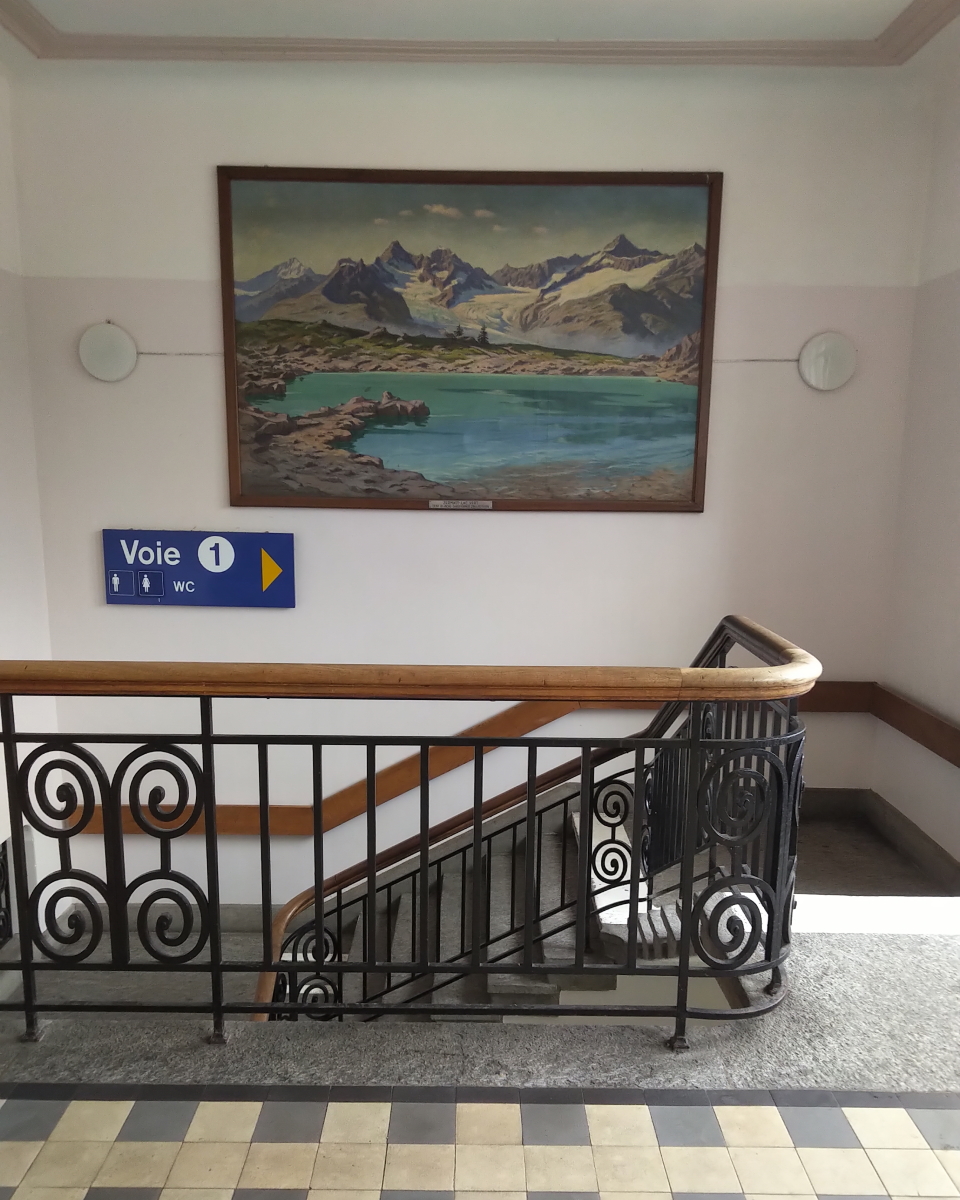 The magnificent staircase in the grand old station in Vallorbe, Switzerland
At Alpine Exploratory we are delighted to advise on wider travel after your hike. We make it our business to know the countries in which we trek. In the case of Switzerland, we offer a number of hikes in Switzerland, and Switzerland is central (geographically and otherwise) to the Alps as a region, so we make sure to know it well... and we love to do so.
Of course, all of the information above on Swiss travel is in service of Alpine Exploratory's hiking routes in Switzerland, including the Walker's Haute Route and the Via Alpina (fomerly the Alpine Pass Route), part of the Tour du Mont Blanc (2 days and 2 half-days in Switzerland) and our forthcoming Jura Crest Trail.
Please ask us about your plans, in Switzerland or elsewhere. We will be delighted to help. Perhaps you have a Swiss travel puzzle that you are keen to crack, or simply a question about buying tickets. We will advise where we can.
Thank you.
Contact us
Holiday Schedule
Travel - our main page for these travel aspects

Alpine Exploratory
Alpine Exploratory is a system of knowledge on the best mountain trekking in our areas, giving clients superb holidays based on this exploration.
About us



 Alpine Exploratory


